Most DeFi power users have lived the small panic: a dApp asks for a signature, you skim the popup, and you hope the gas estimate and destination look right. That moment—when a private key makes economic consequences irrevocable—is where wallet design matters most. Rabby Wallet centers its value proposition on reducing that “blind signing” risk with pre-transaction simulation, approval management, and automated network handling. This article walks through how those mechanisms work, where they meaningfully change user risk, and how Rabby stacks up against familiar alternatives such as MetaMask and Coinbase Wallet for U.S.-based DeFi professionals.
My goal here is practical: give you a reusable mental model for when a simulation-first wallet actually changes outcomes, what trade-offs you accept by switching, and which scenarios still require other controls (hardware keys, multisig, or policy). If you install Rabby or compare it to your current setup, these are the places you should test and measure.
How Rabby’s core mechanisms work (and why they matter)
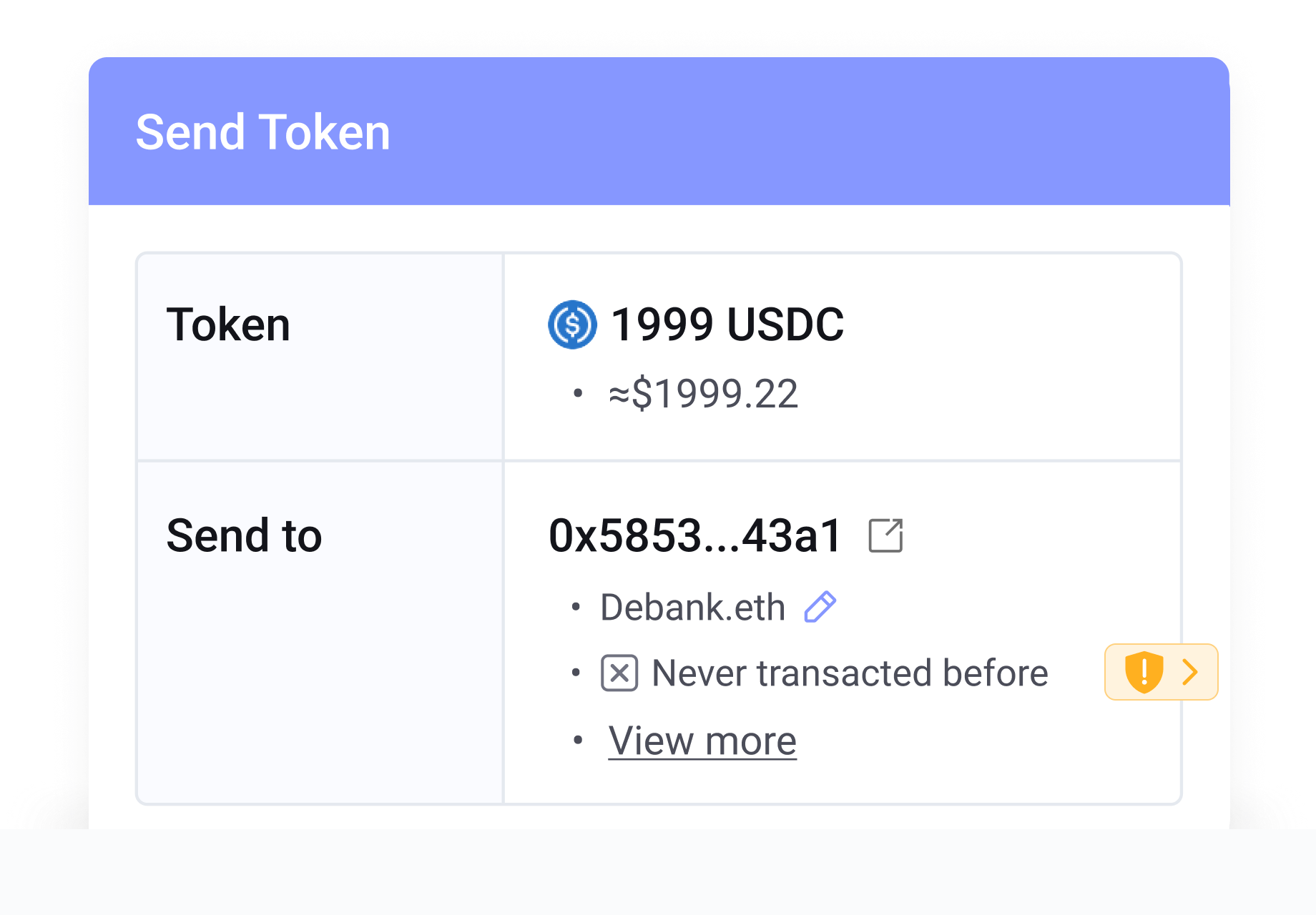
Rabby is a non-custodial, open-source extension originally developed by DeBank. The two features that most materially affect a user’s security posture are its pre-transaction risk scanning and transaction simulation. Mechanistically, Rabby intercepts the raw JSON-RPC call or EIP-1193 request a dApp sends to the wallet and runs a simulation against a node or a local model of chain state. The simulation calculates token balance deltas and gas costs as they would occur on-chain and surfaces those numbers to the user before signing.
That changes the decision point. Instead of trusting a textual description provided by a dApp (which can be misleading or obfuscated), you see a numeric preview: how many tokens will leave your account, which tokens will arrive, and what the estimated fee is. The wallet also cross-references known threat signals—previously exploited contracts, suspicious approval patterns, or nonexistent recipient addresses—so warnings can appear alongside the simulation. For an active DeFi trader moving money across protocols and chains, that is a concrete reduction in attack surface when compared to blind signing.
Rabby complements this with native approval revocation (so you can surgically withdraw ERC-20 allowances) and automatic network switching, which reduces human error when a dApp expects you on Arbitrum or Polygon. It supports over 90 EVM chains and plugs into hardware wallets and enterprise signers—so the simulation + revocation features are available even if you keep keys on a Ledger or route transactions through a Safe.
Trade-offs and limits: what simulation does and what it cannot do
Simulating a transaction is powerful but not omnipotent. A correct simulation depends on accurate chain state and faithful replay of contract logic. That usually works for straight token transfers, swaps, and many DeFi primitives, but it can break in edge cases: contracts that read off-chain data, time-dependent behavior, or contracts that deliberately include non-deterministic elements. If a contract invokes another contract with state-changing side effects outside the simulated node’s view, the preview may under- or over-estimate effects.
Operationally, simulation introduces latency and complexity. The wallet must query data, run an execution trace, and surface results in real time. For high-frequency or UX-sensitive flows, that can slow the interaction. There’s also the human factor: a simulation with technical fields will not help if a user ignores warnings or misinterprets token flows. In short, simulation reduces the probability of error and exploitation, but it does not replace good key hygiene, hardware signing, and institutional controls.
Two other explicit limits to bear in mind: Rabby currently lacks an integrated fiat on-ramp and does not include native in-wallet staking features. If your team wants a single UI for buy/bridge/stake flows, you will still rely on other on-ramps or protocol UIs. Also, Rabby’s past—which includes a 2022 exploit of Rabby Swap contracts with roughly $190k lost—shows that security is social and iterative; the team froze the contract, reimbursed users, and accelerated audits, but no product eliminates systemic contract risk.
Side‑by‑side comparison: Rabby, MetaMask, and Coinbase Wallet
Below I synthesize the most decision-useful contrasts for an institutional or power-user workflow. Focus on three vectors: transaction safety, multi-chain ergonomics, and institutional compatibility.
Transaction safety: Rabby’s simulation + pre-transaction scanning is the clear differentiator. MetaMask and Coinbase provide basic gas and transaction details but historically lacked a built-in transaction simulator and automated approval revocation. For defenders of capital, seeing explicit balance deltas before signing is a material safety upgrade. However, MetaMask has the largest ecosystem compatibility and many third-party tools that plug into it; that breadth matters if you use exotic dApps that depend on MetaMask-specific behaviors.
Multi-chain ergonomics: Rabby supports automatic network switching and 90+ EVM chains, which reduces manual errors when jumping between Layer-2s and sidechains. MetaMask also supports custom networks, but switching is usually manual unless a dApp requests the chain. Coinbase Wallet is friendlier for retail users but less flexible for custom chains and enterprise routing. If you need frequent cross-chain operations and gas top-ups, Rabby’s built-in cross-chain gas top-up and aggregation features are convenient.
Institutional fit: Rabby integrates with Gnosis Safe, Fireblocks, Amber, and other enterprise signers, and it supports a wide range of hardware wallets. MetaMask similarly supports hardware keys and Safe connections; it has broader third-party integrations thanks to its market share. Coinbase Wallet can be simpler to manage across teams using Coinbase’s custodial services but is a different trust model. If your organization requires multisig policies and custody controls, both Rabby and MetaMask can be configured into that stack; Rabby’s simulation can be particularly useful when one signer in a multisig needs to verify intent quickly.
Where Rabby is an operational win — and where you should still be cautious
Rabby is most valuable when you: 1) execute complex DeFi flows across many chains and need to reduce cognitive load and human error; 2) manage approvals actively and want a rapid revocation UI to limit long-lived allowances; and 3) pair non-custodial keys with hardware or multisig for defense in depth. The simulation and pre-scan form a practical mental model: treat every signed request as “simulatable” until proven otherwise.
But be cautious when interacting with novel contracts that reference off-chain or oracle-fed logic; simulations can be blind to external state changes. Also, because Rabby is open-source, attackers can study its code—but that is a double-edged sword: open code invites audits and community scrutiny, which is generally better for security than opaque binaries. Lastly, if your team needs an all-in-one fiat purchase and staking UI, Rabby will require complementary tools.
Decision heuristics: a three-question checklist for whether to install Rabby
Before you install and route critical flows through Rabby, answer these three questions:
1) Do you routinely sign transactions whose exact token flows are nontrivial (swaps, complex approvals, contract interactions)? If yes, simulation reduces a meaningful class of risk. 2) Do you switch networks frequently or use multiple L2s? If yes, automatic network switching and cross-chain gas top-ups save time and reduce accidental failures. 3) Do you already use hardware wallets or multisig? If yes, Rabby’s integrations let you combine simulation with strong signing controls. If you answer “no” to all three, the marginal benefit is smaller.
For readers ready to test Rabby, the project maintains a concise install and feature summary which is helpful for step-by-step setup: https://sites.google.com/cryptowalletextensionus.com/rabby-wallet/
What to watch next — signals that would change how I view Rabby’s risk profile
Watch for three developments. First, improvements in deterministic simulation fidelity (better handling of oracle-fed or cross-contract non-determinism) would widen the class of transactions that can be safely pre-checked. Second, deeper enterprise integrations or native policy controls (e.g., team-wide whitelists, enforced approval timeouts) would make Rabby more attractive to institutional teams. Third, any recurrence of protocol-level exploits associated with Rabby-managed contracts would force a re-evaluation of trust assumptions; conversely, a sustained record of independent audits and bug-bounty results would strengthen confidence.
FAQ
Is Rabby safe enough to replace MetaMask for a professional trader?
“Safe enough” depends on your threat model. For preventing accidental blind signing and managing approvals, Rabby is functionally superior because of pre-transaction simulation and native revocation. For maximum ecosystem compatibility and third-party tooling, MetaMask still has advantages. A pragmatic approach many teams use: keep a hardware-backed MetaMask or a multisig Safe for large or custody-sensitive positions, and use Rabby for rapid trading and allowance management where simulations speed verification.
Can Rabby simulate any smart contract transaction?
Most EVM transactions can be simulated accurately, especially straightforward transfers and swaps. Simulations can fail or be misleading for contracts that depend on unpredictable off-chain inputs, cross-chain callbacks, or intentionally obfuscated logic. Treat a simulation as a strong signal, not an absolute guarantee; if a transaction looks complex, prefer hardware signing and, when possible, test with small amounts first.
How does Rabby work with hardware wallets and multisig?
Rabby integrates with Ledger, Trezor, Keystone, and others, and can be paired with Gnosis Safe and institutional signers. That means you can use Rabby’s UI for simulation and approval revocation while keeping private keys in a hardware or multisig layer—an effective defense-in-depth pattern.
